Monday, October 20, 2008

Hiroshima University and the Peace Memorial

Today we finally got a look at the countryside. We actually got quick flashes of countryside on the bullet train, but traveling out of the city on a bus to Hiroshima University took us through small towns and rice fields; lush, green hills and lots of people on bicycles. The meeting at the University was enlightening. After the delivery of many speeches -- something we’re getting used to by now -- we divided into smaller groups for a more intimate conversation with university professors and students. After much mental calculation and conversion from yen to dollars, our host professor said that it costs about $5000 a year to attend. Several of our group were ready to sent their children.
The first part of the afternoon was spent strolling through the lovely Shukkeien Gardens, filled with ponds and singing birds. It’s beauty was starkly contrasted with the sights we saw at the Peace Memorial. The A-Bomb Dome, whose ruins were left standing as a reminder, is just one of many monuments and museums to visit in the park. There were many school children among the tourists. The all were wearing yellow hats, which our guide told us makes them easy to spot in a crowd. She laughed and said that she didn't have to worry about spotting our group. Many of the children brought paper cranes folded in memory of Sadako, a girl who developed cancer after surviving the initial bomb. Read Sadako and the Thousand Paper Cranes for her full story.

Artifacts, memoirs of survivors, and descriptions of the awful events which led up to and followed that tragic event on August 6, 1945, would convince any visitor to join with the survivors in saying, “Never again!”

Sunday Travels


Today was supposed to be just a travel day, and travel we did -- this time by bullet train to Hiroshima. As we sped through the countryside, we got glimpses of mountains (even Mt. Fuji several different times), fields, towns and cities. If it
had been a slower train, I might have gotten some great pictures, but as it was I had another great photo opportunity after we arrived in Hiroshima.
Because we arrived early in the afternoon, our guide arranged for the bus to take us on a side trip before settling in at our hotel. After traveling about an hour, we took a fer
ry to an island with the
Today was supposed to be just a travel day, and travel we did -- this time by bullet train to Hiroshima. As we sped through the countryside, we got glimpses of mountains (even Mt. Fuji several different times), fields, towns and cities. If it Miyajima Island and its famous shrine. The distinctive red gate in the harbor is a famous Japanese photo.
We ate at a little family-owned restaurant near our hotel. When the menu was only in Japanese, we had to all go back outside, so we could each point to the food in the window that we wanted to try.
This hotel is beautiful if not as large as the New Otani in Tokyo. The rooms are comfortable, stocked with everything you’d need, but SMALL!!! By the time our bags are delivered tomorrow, we won’t even have walking space.

Adventures on the Town

Today (Saturday) was our only free day. Some people took side trips out of Tokyo, which were expensive and required a good portion of the day being used up going to and from their destination. A group of us decided to explore a couple of the many sights to see here in the Tokyo.
The first order of business figuring out how to get where we wanted to go -- easier said than done. We’d already had the harrowing taxi ride, so we decided to brave Tokyo’s efficient but complex subway system. It’s a virtual warren of color-coded tracks intertwining beneath the city. I’m sure we provided some amusing anecdotes for native Tokyo-ites (??Tokyo-ans??) as they described observing a group of middle-aged Americans poring over a map and retracing their steps before at last boarding a train. We nearly headed off in totally wrong directions but ultimately made no errors.
It was a beautiful day for strolling through the Imperial Palace Gardens. We could identify some flowers and trees and mis-identified bamboo before we came across the real thing. People were sitting in the shade on benches or on the ground under a tree. One man was sleeping, stretched out on the ground in the middle of a lawn. Although we saw homeless people later in the park near the National Museum, this man seemed just to be enjoying the sunshine.
After another subway adventure, we opted for some culture in the National Museum. It sits in Ueno Park, which is filled with tree-lined paths, people of every sort, street performers, and the Japanese version of an ice cream truck -- this one again serving interesting flavored soft-served ice cream with no identifying flavors, at least not in English.
I was intrigued by watching a number of people eating a food that I couldn’t identify. It was long and red on the outside (at first I thought it was a red banana-like fruit I’ve seen here) with a yellow inside. People were buying them from a vendor, breaking them open , peeling the skin, and eating the inside. They smelled good, so I decided to buy one. When I stood in line, I noticed that they were shaped more like a sweet potato. It was almost too hot to hold and break apart, but it turned out to be some kind of potato. Oishii!
Tomorrow we take the bullet train to Hiroshima. Another new experience.

Friday, October 17, 2008

Contrasts


Somehow it’s Friday already. The morning’s presentation was emotionally draining. We heard Tomoko Yanagi, a high school English teacher whose father is a survivor of the Hiroshima bombing and Kejiro Matsushima, who is a survivor himself. Tomoko spoke well, but the telling of her father’s story did not prepare us to hear Matsushima-san tell us what happened to him, minute-by-minute on that fateful day. He kept talking about how lucky he was and thanked Buddha for his good fortune, all the while describing the horrors he witnessed. I will be bringing back a DVD of his talk that I hope to share with students.
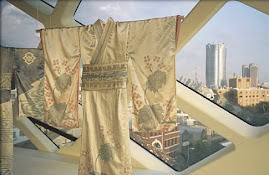
On a lighter note, this afternoon we heard a lecture that was advertised as a presentation on traditional Japanese theater but was so much more. We did have a history lesson but also learned about the music that accompanies the various kinds of theater (we sang a song that the speaker said the Japanese people think is traditional, but it’s sung to the tune of “Auld Lang Syne”) and saw a Nihon Buyo dance accompanied by singers and a woman playing shamisen, a stringed instrument. I had seen the dancer with her daughter earlier in the hotel and asked to take their pictures -- the mother in traditional kimono and her teenaged daughter. Imagine my surprise when she came out on stage!
Before the day ended, we met with the group who is going to Hiroshima on Sunday. Our guide told us that we were the “lucky ones” because there is so much to see in that city. We will be visiting 4 different schools during our week there. It was announced that I will be giving the speech of appreciation to the mayor of the city on behalf of the group--no pressure there. Our guide said that I had been selected because I was the highest member of the group. It wasn’t clear if she meant that I was the oldest or merely had the highest degree.
Tomorrow is our only free day, so tonight while we’re out looking for more mysterious food to sample, we’ll be making plans for our next adventure.

Thursday Lectures

Jet lag finally caught up to me. Luckily being awake at 5:00 a.m. has its advantages. I got a picture out my window of the setting full moon against the Tokyo downtown skyline at sunup. Since I was up anyway, I went for a walk in the gardens I had been viewing from my window.-- waterfall, koi ponds, lush foliage, singing birds -- simply gorgeous!
After a sleepless night, I had doubts about a day of lectures. Luckily all our Japanese speakers were engaging and spoke about complex subjects at a level I could understand.
I had read about the history of the Japanese education system, but found myself fascinated by our keynote speaker, Mr. Katsuhide Kusahara (Vice-President of Tabushoku University) and his description of problems their schools are facing. He talked about a new plan called ESD (Education for Sustained Development), which the Japanese Prime Minister recently presented at the G8 summit, calling it an “opportunity to reconfigure the very essence of education.”
Prof. Takahiro Miyao, of the International University of Japan, explained the Japanese economy in simple enough terms that even I got a rudimentary grasp of the GPD, PPP, and BIG MAC index as well as NEETs and Freeters. Ask me when I get back to see if I can still remember what they are.
Mr. Yuji Tsushima, Diet member of the House of Representatives , and Prof. Hiroya Ichikawa of Akita International University spoke about government and the relationship between the U.S., Japan, and the global economy. Whatever meeting Tsushima-san rushed off to must have been important because I saw him on the news the next morning. Unfortunately, I had on a Japanese news program, so I have no idea what they were saying about him.
After sitting all day, it was great to get out for our first free night on the town. After a thrilling taxi ride to shop at the Hard Rock CafĂ© (most side streets are very narrow), we returned to the hotel and walked to a 100 Yen Store -- like our Dollar Stores. We then wandered around, looking at pictures of food on menus that restaurants post out front. We finally decided on one, mostly because we were tired of walking. Idt We didn’t know what we were ordering when we pointed at the pictures on the menu -- but it was all delicious. Later we found out that it was actually a Chinese restaurant.
Tomorrow we see some Kabuki Theater.

Wednesday, October 15, 2008

Sightseeing in Tokyo


Today (it’s Wednesday here) was busy. It was interesting to see salad and vegetables served alongside bacon and eggs for breakfast-- the latter a concession to American guests. I’m learning how many things we assume to be a certain way -- what side is the UP escalator , for instance. We went sightseeing and started at the Diet, which is the Japanese Parliament. There were many groups of school children on field trips, dying to get their picture taken.
We then went to the Asakusa area, named after a shrine that was having a big celebration today. We had a traditional tempura lunch for which we did have to sit on the floor -- more food whose origin was unclear, although we made a guess on everything.
We had about 1.5 hours for shopping and looking at all the shrines. There was soft-serve ice cream in the flavors you’d expect in addition to unexpected flavors such as bean curd, green tea, and plum. I tasted the green tea flavor, which was aptly named -- not a flavor I would associate with ice cream. Another fun thing I saw reminded me of the state fair. A man had a booth set up with bulls-eye targets where you could pay to try to shoot one with a bow and arrow. I saw a girl hit the target -- a lot of bells were rung, but I didn’t see her get a prize. The temple, shrines, and gardens were beautiful. Many people left money or burned incense in honor of ancestors.
Tonight’s official welcoming reception involved a lot of speeches, plentiful drinks, and more new foods to try. Tomorrow I hope to visit the hotel’s expansive gardens, waterfall, and koi pond that I can see from my window that looks out on downtown Tokyo.

San Francisco and on to Tokyo


Orientation in San Francisco started out with bad news and good news. Listening to lists of things to do (take off your shoes before stepping on wooden floors) and not to do (chew gum in public) was long but not the bad news. The director announced that because of budget cuts, our group would be the last of 12 years of JFMF (Japan Fulbright Memorial Fund) teacher programs. We felt very lucky and sorry for those who have applied several times and not gotten to go yet.
The good news was the reception at the Japanese Consulate on a hill overlooking the Bay. We got a preview of Japanese food before heading back to the hotel to try and sleep.
Sunday/Monday brought 21 hours of being awake, 12 of which were the plane ride which started an hour late and then took 2 hours longer than anticipated. They showed 4 full-length movies.
As exhausted as we were, most of us opted to go out to our first dinner in Tokyo with volunteers who were former JFMF participants. The guide for 5 of us was a retired economic
s professor. He took us to a restaurant within walking distance of our unbelievable hotel -- luxury, individual rooms. The tables at the restaurant were low, but there was a pit for our legs, so we didn’t have to sit on the floor. Our host ordered a variety of foods to share, and we often didn’t know what we were eating, but it was all Oishii -- delicious. The wood block in the picture is the "key" to the cubby where we left our shoes.

We were literally falling asleep in our plates by the time we headed back.